Silence is expensive in hospitality. When a potential guest asks about parking before booking, or an in-house guest texts for extra pillows, they want an answer now. For front desk teams juggling check-ins and phone calls, keeping up with an endless influx of digital pings is an exhausting game of whack-a-mole.
These days, however, chatbots are giving properties a faster, scalable way to communicate across every stage of the guest journey. In fact, Canary’s Navigating AI report found that 51% of hoteliers are already deploying AI and 82% are scaling up their usage this year, highlighting that guest communication is where the industry is winning back its time. To get started, here is your step-by-step hotel chatbot implementation guide to a successful chatbot strategy for your property.
Key highlights:
Hotel chatbots are communication tools that automate guest interactions across websites, messaging channels and voice conversations.
Successful chatbot rollouts depend on clear goals, strong system integrations and staff alignment from day one.
Hospitality-specific AI understands hotel workflows, guest expectations and operational nuances.
Canary Technologies provides an AI-powered Guest Management System for hotels that unifies guest communication, automation and operational workflows across the entire guest journey.
What Is a Hotel Chatbot?
A hotel chatbot is an automated communication tool that can answer guest questions, manage requests, and support hotel operations across digital channels such as websites, text and messaging apps. There are two types.
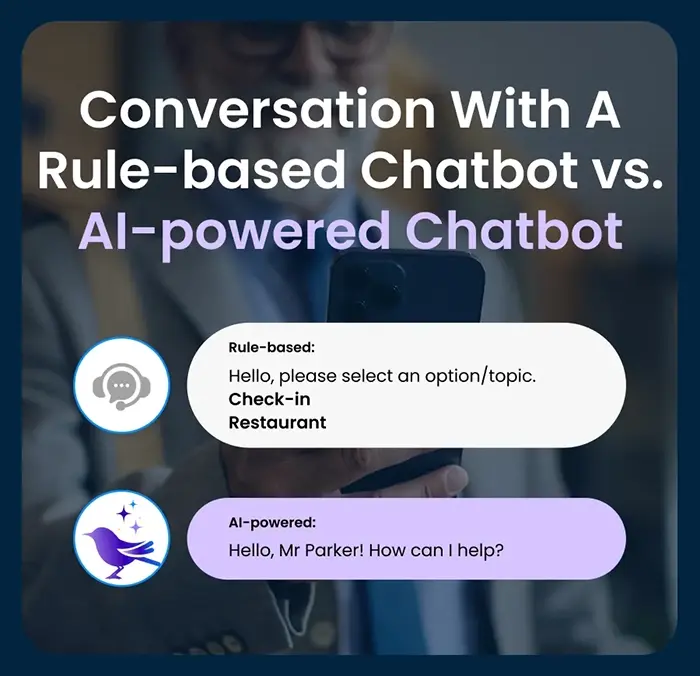
Rule-based chatbots are programmed to respond to specific prompts or keywords with static responses. AI-powered hotel chatbots, by contrast, use natural, hospitality-specific language processing to understand guest intent, respond conversationally and automate workflows. As more hoteliers adopt AI, these more advanced solutions are becoming essential components of modern hotel operations and guest engagement.
How to Implement a Hotel Chatbot
According to HotelTechReport, 70% of guests find chatbots useful for simple inquiries. If that stat has you rolling up your sleeves and looking for the best installation option, take a beat. A successful hotel chatbot rollout requires clear operational goals, strong internal alignment and a deployment strategy. Connection between all your communication and departments like front desk, reservations, marketing and IT is key. Here’s how to do it in six steps.
Step 1: Define Objectives and Success Metrics
Before you sign a contract with a chatbot platform, you must take a hard look at your current call volume and digital message logs. What is driving the noise at your property? Do website visitors need clarification to convert? Or are questions from in-house guests keeping your team on their toes? Your goals may range from converting lookers to bookers to reducing call volume and front-desk workload while improving response times.
Establish measurable KPIs early so teams can evaluate performance after launch. Common chatbot success metrics include:
Average response time
Guest satisfaction scores
Direct booking conversions
Upsell revenue generated
Reduction in repetitive guest inquiries
Staff time saved on manual communication tasks
Step 2: Prepare Your Knowledge Base
Whatever your front desk team knows off the top of their head, your chatbot needs to know, too. Using the training you already provide staff as a starting point, organize a knowledge base: a way to centralize the operational information guests most frequently request before you deploy the new tool. This ensures responses remain accurate, consistent and aligned across channels.
By taking this step now, you get the results you want and reduce your future workload. Plus, you can always add to your knowledge base as you learn what types of more unusual questions your chatbot handles once deployed. But first, focus on building an initial knowledge base that includes:
Check-in and checkout policies
Parking and transportation information
Amenity details and hours
Dining and room service information
Loyalty program FAQs
Upsell offerings and packages
Local recommendations and property policies
Step 3: Select Hotel Guest Communication Channels
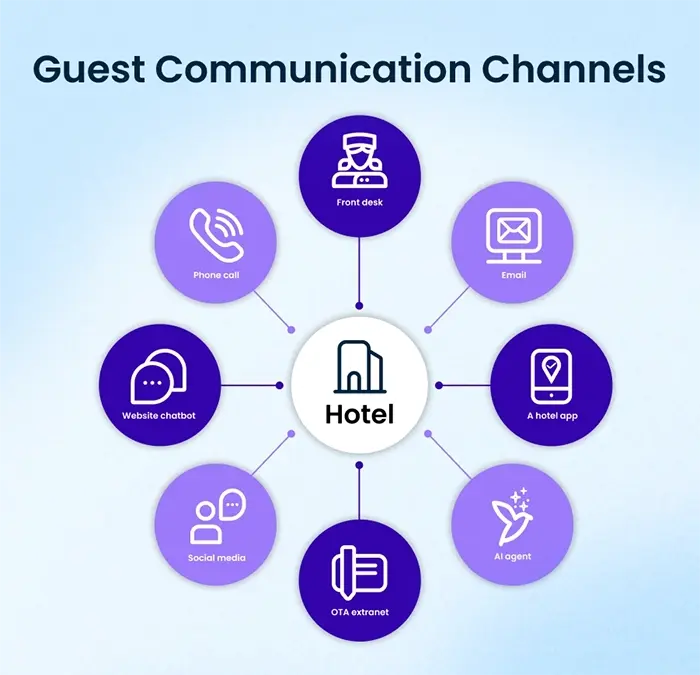
When was the last time you checked your hotel’s DMs, WhatsApp messages or Expedia pings? Some hotels don't even realize how many channels they’ve left open. Regardless of how many channels your property currently uses, now is the time to become selective and intentional — directing traffic away from your costliest or most painful channels and toward scalable ones.
The right channel strategy depends on guest demographics, operational workflows and where communication bottlenecks currently exist. Many hotels prioritize a combination of:
Website chat
Text messaging
WhatsApp or social messaging apps
Mobile app messaging
AI-powered voice support
Step 4: Integrate with PMS and Core Systems
Your chatbot needs to know your guest. You make that introduction by connecting your chatbot to your property management systems (PMS). This integration takes it from a simple FAQ tool to an operationally valuable AI platform. Suddenly, your AI has access to reservation details to personalize interactions and automate tasks in real time.
Beyond the PMS, hospitality-specific AI platforms should integrate with any relevant systems. So if you want a guest's towel request to be answered and fulfilled, connect the chatbot to your housekeeping tool. Hotels should prioritize integrations with:
PMS platforms
Customer Relationship Management (CRM) systems
Housekeeping platforms
Mobile check-in solutions
Payment and upsell systems
Ticketing or service management platforms
Step 5: Train Hotel Staff and Establish Escalation Protocols
Even the best AI solution still requires strong human oversight. Hotel teams should understand how the chatbot works, when conversations escalate to staff and how to manage guest interactions when additional support is needed. Reducing admin work this way frees staff to focus on delivering the best service possible.
Chatbot rollout and staff training should go hand in hand. A strong staff training plan should include:
How to monitor chatbot conversations
Escalation procedures for complex guest requests
Brand voice and communication standards
Updating chatbot knowledge over time
Troubleshooting guest communication issues
Step 6: Test, Launch and Optimize
Guest expectations will evolve and AI capabilities will improve, so ongoing refinement is what keeps your chatbot delivering value for guests and staff alike. Thoroughly test chatbot workflows across every major guest scenario before going live, then monitor and optimize. This means evaluating response accuracy, escalation handling, integrations and channel performance under real operational conditions — testing scenarios like a room service request or a question about the nearest grocery store. After launch, continuous optimization is critical.
Hotels should regularly review:
Guest feedback and satisfaction data
Common unanswered questions
Conversion and upsell performance
Escalation trends
Operational bottlenecks
How to Select the Right Hotel Chatbot Solution
A Harvard Business Review Analytic Services study, conducted in partnership with Infobip, found that while 93% of surveyed leaders consider positive conversational experiences highly important, just 11% say their organization is highly effective at using AI to deliver human-like interactions — with integration challenges among the roadblocks cited. Because generic e-commerce chatbots collapse under the operational realities of hospitality, selecting a hotel-native solution is critical.
Look for AI chatbots for hotels that understand industry terminology, integrate deeply with your PMS and escalate complex queries seamlessly to your live front desk team. Here is what you need to consider.
1. Evaluate How It Will Integrate
The most effective hotel chatbots connect directly with the systems hotels already use every day. Without strong integrations, chatbot conversations remain isolated from the rest of the guest experience and can create more work for staff. With a clear map of your systems and workflows in hand, you'll know what integrations to ask vendors about.
Some rule-based chatbots simply answer FAQs. More advanced hospitality AI platforms automate workflows, complete tasks and manage guest interactions end-to-end. Understanding this difference is critical when evaluating long-term operational value, so test chatbots to see what your guests will actually experience.
Look for platforms that support advanced hotel automation capabilities like:
Automated AI guest messaging
AI-powered booking assistance
Upsell recommendations
Service request management
Reservation modifications
Multi-language communication
3. Review Analytics and ROI Tracking
Seeing is believing. Strong reporting tools show hotels how chatbot performance impacts operations, revenue and guest engagement. Without clear analytics, it's difficult to measure ROI or identify areas for improvement after deployment. Regular review lets your team spot anomalies and drive improvements to the knowledge base and system.
Evaluate reporting capabilities such as:
Response and resolution rates
Guest satisfaction metrics
Booking conversion data
Upsell revenue attribution
Staff workload reduction
Escalation and handoff trends
4. Confirm Security and Compliance Standards
Hotel chatbots process sensitive guest information, including reservation details, payment data and personal contact information. That makes security and compliance a critical part of vendor evaluation. Weigh any legislation and accreditations relevant to your location alongside the criteria in this guide.
Assess whether platforms follow strong hotel cybersecurity best practices, including:
PCI compliance
Secure guest authentication
Data encryption
Role-based access controls
Audit logs and monitoring
Compliance with regional privacy regulations
Simplify Hotel Chatbot Implementation with Canary
Canary Technologies delivers the industry’s leading hotel AI chatbot platform built specifically for hospitality operations. It's already powering millions of guest interactions for hotels around the world, offering a scalable way to modernize operations so staff can focus on higher-value guest service.
Unlike generic AI tools, Canary’s hospitality-specific AI powers guest communication, automates workflows and connects directly with the systems hotels already use every day. The result is faster service, less administrative work for staff and a smoother guest experience from booking through post-stay. With Canary’s AI-powered Guest Management System, hotels can:
Automate guest communication across webchat, messaging and voice channels
Answer guest questions instantly with hospitality-trained AI
Reduce front desk workload by automating repetitive requests
Surface personalized upsell offers throughout the guest journey
Integrate directly with PMS, CRM and core hotel systems
Deliver multilingual guest support at scale
Improve response times and guest satisfaction
Create a connected guest experience across every digital touchpoint
Book a demo today and see how Canary can help streamline hotel chatbot implementation for your property.
Frequently Asked Questions
What are the main benefits of AI-powered chatbots in the hospitality industry?
AI-powered hotel chatbots are the driving force behind faster, more personalized guest service at scale today. They automate answers for routine guest inquiries, reduce pressure on front desk teams and provide instant support across digital channels 24/7.
Modern hospitality chatbots also support functions like room service requests, upsell recommendations and virtual concierge experiences that guide guests throughout their stay. Hotels using AI-powered communication tools often see faster response times, stronger guest satisfaction and more streamlined operations. Learn more about the broader chatbot benefits for hotels.
What is the timeline for a hotel chatbot implementation?
The timeline for hotel chatbot implementation depends on factors like the volume of required system integrations, property size and operational complexity. Some hotels can launch basic chatbot functionality within a few weeks, while larger deployments across multiple websites and mobile apps may require additional configuration and testing.
A successful rollout typically includes goal setting, knowledge base preparation, system integrations, staff training and workflow testing before launch. Hospitality-specific AI platforms with prebuilt hotel integrations generally reduce deployment time significantly.
Can I integrate a hotel chatbot with my PMS?
Yes. Most modern hotel chatbot platforms integrate directly with PMS and other core hotel technologies so they can access reservation details, personalize guest communication and automate tasks like check-in support, room requests and service updates.
Hotels should prioritize chatbot solutions with strong built-in hospitality integrations to avoid disconnected workflows and manual processes. Connected systems create an easier experience for both guests and hotel staff.
Can hotel chatbots handle booking modifications?
Yes. Advanced AI-powered hotel chatbots can manage booking modifications like date changes, room upgrades, cancellations and reservation updates by integrating with hotel booking engines and reservation systems.
Hospitality-specific AI platforms can also personalize recommendations based on guest preferences, loyalty status and stay history. Learn more about how integrations with a hotel room reservation system support automated guest communication and booking management.








.avif)
.avif)