



Every unanswered guest question costs you something: a better review, a happier guest or an hour of your team’s time. Automation can close that gap, but only if you pick the right kind. Before investing, you need to know the difference between chatbots and conversational AI.
While traditional chatbots handle basic, rule-based interactions, conversational AI delivers more natural, context-aware conversations and can take action on guest requests. This guide explains how the two technologies differ, why conversational AI is essential for modern hotel operations and how Canary Technologies turns guest communication into efficiency, revenue and guest satisfaction.
Key Takeaways
- Chatbots are automated tools that respond to user questions based on predefined rules, decision trees or programmed responses for handling simple, repetitive inquiries.
- Conversational AI uses natural language processing and machine learning to understand guest intent, interpret context and deliver more personalized interactions.
- While traditional chatbots follow fixed scripts, conversational AI adapts to the conversation and handles a wider range of guest questions and requests.
- Conversational AI provides faster, more personalized service while automating repetitive tasks, capturing additional revenue and freeing staff to focus on high-value guest interactions.
- Canary’s hospitality-specific AI solutions, including AI Webchat, AI Voice and AI Guest Messaging, automate guest communication across channels and connect interactions to hotel workflows, improving efficiency and the guest experience.
What Is a Chatbot?
A chatbot is an automated tool that responds to guest questions and requests using predefined rules, scripts or decision trees. In hospitality, chatbots are mostly used on hotel websites for routine interactions such as answering frequently asked questions (FAQs), sharing booking confirmations and providing basic information about hotel amenities, check-in times or services.
Traditional chatbots work best when guest inquiries follow predictable patterns. They match questions to programmed responses or guide guests through set options, such as selecting a reservation detail or requesting a standard service. This approach automates basic interactions and reduces repetitive work for staff, but it breaks down when guests ask unexpected questions or need help with more complicated requests.
What Is Conversational AI?
Conversational AI is technology that uses natural language processing (NLP), machine learning and contextual understanding to interpret guest requests and deliver relevant, human-like responses. In hospitality, it goes beyond answering basic questions to manage more complex interactions, from handling guest requests to personalizing offers. Its uses extend beyond website chat to include guest text messaging, answering phone calls, routing messages that need staff attention and suggesting replies for staff to send.
Unlike traditional chatbots, conversational AI interprets guest intent even when a question is phrased unexpectedly or depends on context. Hospitality-specific solutions also connect conversations to reservation data in the property management system (PMS) and operational workflows, so they can resolve more inquiries than their scripted predecessors. This kind of AI is already doing real work across industries: in Salesforce’s 2025 State of Service (new tab) research, service teams estimated that AI handles about 30% of their cases today, and they expect that to reach 50% by 2027.
Chatbot vs. Conversational AI: Key Differences
Both chatbots and conversational AI support automated guest communication, but they differ in how they understand questions, respond to guests and handle requests. Traditional chatbots are limited to predefined rules and scripts. Conversational AI uses NLP and contextual understanding to handle a much wider range of requests.
For a detailed look at different solutions, explore our guide to hotel chatbots.
The key difference shows up when a guest asks one more question: a chatbot replies with some version of “Sorry, I can’t help with that,” while conversational AI keeps the conversation going. For guests, that’s the difference between a frustrating search for information and a smooth experience. For hotels, it means meeting a wider range of guest needs with less repetitive work for staff.
How Conversational AI and Chatbots Work
Both chatbots and conversational AI improve response times. The Center for Management Science Research (new tab) reports a decrease from 30 to 18 seconds while increasing interactions, resolution rates and guest satisfaction scores. Behind the scenes, they work very differently. Understanding how each technology works makes it easier to determine which solution best fits your hotel's needs.
Static Chatbot Workflow
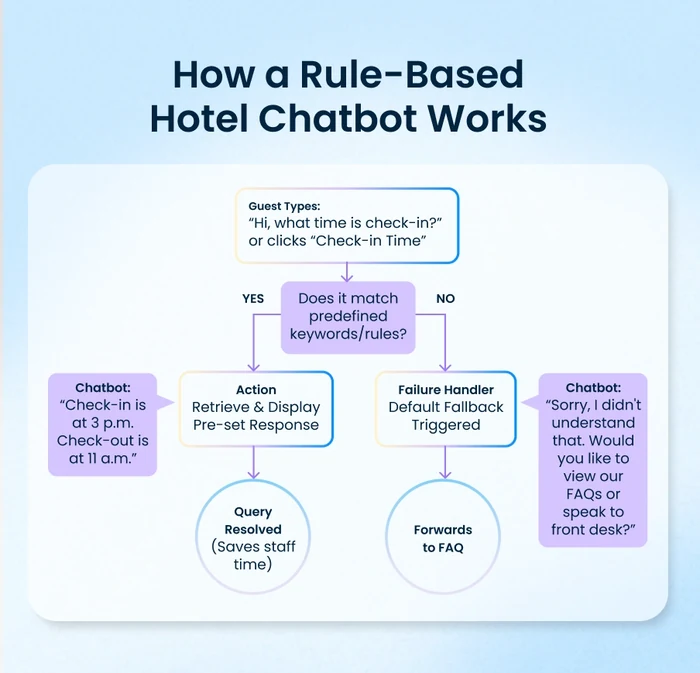
Traditional chatbots follow a structured workflow built around predefined scripts, rules and decision trees. All of these are determined by you, which your team writes and maintains. The system looks for keywords in a guest’s question, matches them to a programmed option and returns the scripted response. This approach works well for the questions and scenarios you programmed, but struggles with the unusual questions your front desk hears every day.
A typical static chatbot workflow follows these steps:
- Guest submits a question: A guest types a question or selects an option in the chat interface.
- Chatbot identifies a match: The system checks the input against predefined keywords, rules or decision-tree paths.
- Chatbot returns a response: The system displays the corresponding scripted answer or directs the guest to a relevant resource.
- Unrecognized requests are redirected: If the chatbot cannot find a suitable match, it may repeat a prompt, offer limited alternatives or direct the guest to hotel staff.
Conversational AI Workflow
Conversational AI follows a more flexible workflow that combines NLP, machine learning and contextual understanding to interpret guest intent. Rather than relying on exact keyword matches, it analyzes the meaning of a message and generates a relevant response drawn from your hotel’s knowledge base and connected systems. In other words, the wording may vary each time a guest asks about check-out, but the answer comes from the same approved source, so the check-out time stays consistent.
Depending on its integrations and configuration, conversational AI can also retrieve hotel-specific information, take action on guest requests and escalate conversations that require staff involvement. A typical conversational AI workflow follows these steps:
- Guest submits a question or request: The guest communicates naturally through a channel such as webchat, text messaging or voice.
- AI interprets intent and context: The system analyzes the guest's language, identifies the request and uses relevant conversational context to understand what they need.
- AI retrieves relevant information: The system draws on available hotel information, knowledge sources and connected systems to formulate an appropriate response.
- AI responds or takes action: The system provides a contextual answer or, when configured with the necessary integrations and permissions, completes an operational task such as processing a routine request or updating a connected system.
- AI escalates when needed: If a request falls outside its capabilities or requires human judgment, the system can route the conversation to a staff member.
- Performance improves through feedback and updates: Depending on the solution, teams can review interactions, refine instructions and update knowledge sources to improve future responses.
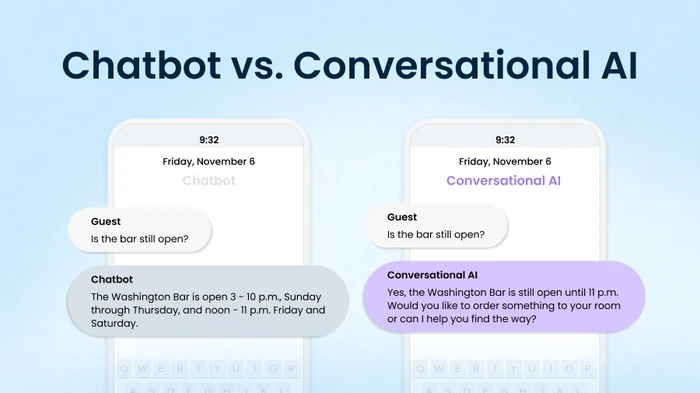
The biggest distinction is that conversational AI moves beyond matching questions to scripted answers. In practice, it’s the difference between a guest receiving the bar’s full weekly schedule and hearing, “Yes, the bar is open until 11 p.m. tonight.”
Benefits of Conversational AI for Hotel Guest Experience
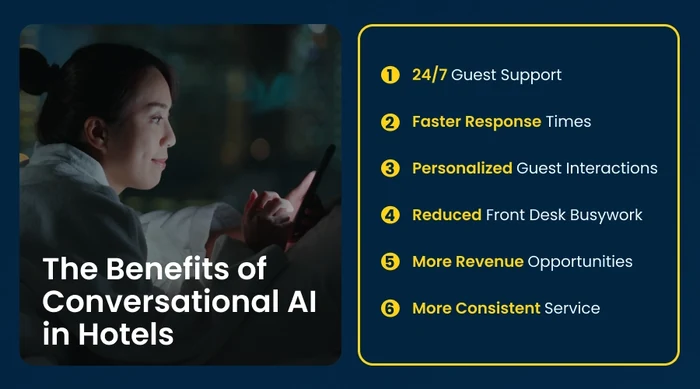
Conversational AI delivers operational and guest experience benefits that traditional chatbots do not. It understands guest intent, responds in natural language and connects conversations to hotel workflows, which gives guests faster access to information while reducing repetitive work for staff. This creates opportunities for hotel guest engagement that either didn't exist before or were missed due to busy phone lines—but that’s not all.
24/7 Guest Support without Increasing Staff
Guest questions don’t keep business hours. A missing toothbrush gets noticed late at night, and a guest who finally gets to bed at 3 a.m. wants to know the check-out time right now. Conversational AI provides round-the-clock support across digital channels, answering routine questions even when the front desk team is busy or unavailable. Hospitality-specific AI also interprets a wider range of questions and responds based on relevant hotel and guest information.
By automating common inquiries, hotels can extend service without adding staff. Solutions such as AI chatbots for hotels give guests a convenient way to get answers while freeing employees for in-person service. With conversational AI, hotels can:
- Answer questions around the clock: Provide guests with information about amenities, policies and services at any time.
- Support multiple communication channels: Respond through webchat, text messaging and voice, depending on the solution.
- Reduce after-hours interruptions: Automate routine inquiries that would otherwise require staff attention.
- Escalate complex requests: Route conversations to hotel employees when a request requires human judgment or intervention.
Faster Response Times for Guest Requests
Response time shapes how guests perceive hotel service. If a guest on a delayed flight can’t find out about parking or whether the restaurant will still be serving when they get in, frustration builds before the stay even begins. Real-time conversational AI provides information without waiting for an employee. It also handles multiple conversations simultaneously, reducing bottlenecks during busy periods.
Faster responses benefit hotel operations, too. By automating repetitive communication, conversational AI reduces the queue of messages and calls staff must handle manually. Guests receive timely answers while employees spend less time switching between communication channels and more time resolving complex issues. Conversational AI improves hotel responsiveness by:
- Providing near-instant answers: Resolve common questions without requiring a staff member to respond individually.
- Handling concurrent conversations: Support multiple guests at once during peak check-in times and other busy periods.
- Reducing communication backlogs: Address routine inquiries before they accumulate in the inbox.
- Keeping service consistent: Deliver relevant answers across supported channels and hours of operation.
Personalized Guest Interactions at Scale
Guests expect service that reflects their needs, preferences, language and stage of travel. Conversational AI makes personalized communication easier to deliver at scale by interpreting each inquiry in the guest’s language and drawing on relevant hotel information and available guest context. Instead of relying solely on generic, scripted replies, it can tailor responses to the conversation and provide recommendations that fit the guest's request.
Personalization also creates opportunities to generate incremental revenue without making every interaction a manual task. For example, a guest asking about an early arrival might receive information about early check-in availability, while a guest asking about dining might receive relevant restaurant recommendations. When supported by the hotel's systems and configuration, AI-driven communication makes these offers more timely and useful. Hotels can use conversational AI to:
- Tailor responses to guest needs: Use conversational context and relevant guest information to make interactions more useful.
- Recommend relevant services: Surface options such as dining, spa treatments or late checkout when appropriate.
- Support multilingual communication: Respond in guests' preferred languages and translate requests for staff in supported languages.
- Create more consistent experiences: Deliver relevant information across digital touchpoints throughout the guest journey.
Learn more about improving the hotel guest experience.
Reduced Front Desk Workload
Being available to guests is an art hoteliers perfect every day. Routing repetitive questions to automated channels frees staff to be present for the guests who need them. Conversational AI takes on many of these repetitive interactions, reduces manual work and manages competing demands more efficiently.
AI works alongside hotel teams, not in place of them, giving staff time back for the human side of hospitality. Employees can focus on high-touch requests, resolve sensitive issues and build stronger guest relationships. When integrated with hotel systems, conversational AI can also support operational workflows beyond answering questions, extending its value across the hotel front desk. Conversational AI reduces front desk workload by:
- Automating repetitive questions: Handle common inquiries about check-in, parking, amenities and hotel policies.
- Reducing phone and message volume: Resolve routine requests without requiring staff to manage every interaction.
- Prioritizing high-value guest interactions: Give employees more time for personalized, in-person service.
- Streamlining request management: Connect conversations to supported hotel workflows to reduce manual follow-up and duplicate work.
How to Implement Conversational AI for Hotel Guest Messaging
Ready to get started? You’ll be in good company: 85% of hotel IT decision-makers said they plan to put at least 5% of their IT budget toward AI this year, according to Canary’s 2026 AI in hospitality report. Start by defining why your hotel needs conversational AI, then turn that into a plan with clear goals and a view of how it will fit with your existing technology. The steps below walk through the process.
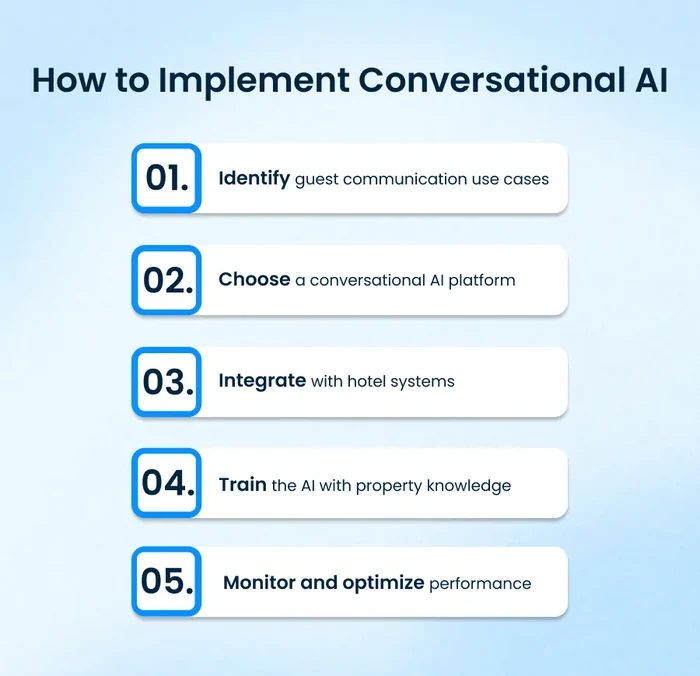
1. Identify Guest Communication Use Cases
First, look at how your guests communicate with your hotel before, during and after their stay. List “the usual” questions and common requests that consume your staff’s time right now. Prioritizing these workflows gives them time to focus on meaningful improvements in response times, efficiency and guest satisfaction. Don’t forget to include post-stay messaging, which can drive future direct hotel bookings.
When assessing potential use cases, consider both the frequency of each interaction and the value of automating it. Begin with predictable, high-volume conversations, then expand to more complex workflows as your platform and integrations allow. Common starting points include:
- Frequently asked questions: Automate responses about check-in and check-out times, parking, amenities and hotel policies.
- Guest service requests: Help guests request extra towels, housekeeping or other routine services.
- Pre-arrival communication: Answer questions about reservations, arrival details and available upgrades.
- Revenue-generating interactions: Identify appropriate opportunities to promote early check-in, late checkout, room upgrades or on-property services.
2. Select a Conversational AI Platform Built for Hospitality
The reality of hotel operations includes a PMS full of guest data, as well as guest-facing and team-facing technologies. General-purpose AI tools may offer conversational capabilities, but hospitality-focused solutions are better positioned to address guest journey needs, property-specific questions and the workflows hotel teams manage every day. The goal is natural, context-aware conversation that keeps staff involved when requests require human judgment.
The right platform must fit into your existing technology environment. Canary's AI Guest Messaging makes it practical to manage guest conversations at scale, supports the communication channels hospitality relies on, connects with hotel systems and gives your team visibility into interactions. Key capabilities to consider include:
- Hospitality-specific knowledge: The ability to respond using accurate information about your property's services, amenities and policies.
- Multichannel communication: Support for the guest messaging channels your hotel uses, such as SMS and webchat, depending on the solution.
- Integration capabilities: Connections to relevant hotel systems and workflows to reduce manual work.
- Human escalation: Clear processes for routing complex, sensitive or unresolved requests to staff.
- Performance visibility: Reporting or interaction reviews that help your team assess response quality, identify gaps and improve results.
3. Integrate the AI Chat Solution with Your Property Management Systems
Conversational AI is most useful when it works alongside the systems your hotel already relies on. Integrating an AI chat solution with your PMS and other relevant hotel technology connects guest conversations with reservation details and operational workflows. A hospitality-focused vendor should be able to tell you quickly which systems it supports and what information and actions the AI can access.
A well-planned integration is actively supported by the vendor and designed to reduce the need for staff to switch between tools or manually transfer information from one system to another. Before going live, work with your technology providers to define permissions, data flows and escalation procedures. Focus on the following steps:
- Confirm system compatibility: Verify that the AI platform supports your PMS and other essential hotel systems.
- Map the required workflows: Determine which guest requests need reservation context or an action in a connected system.
- Set access and permissions: Ensure the AI can access only the information and functions needed for its intended tasks.
- Test end-to-end scenarios: Check that guest messages, system responses and staff handoffs work as expected before launch.
4. Train the Conversational AI Using Property Knowledge and FAQs
To answer like your team, conversational AI needs the same property-specific information your team relies on. Conversational AI draws on a knowledge base: information you prepare, covering common guest questions, hotel policies, amenities, operating hours, services and other details guests regularly ask about. Your vendor provides the knowledge base tool, and your team keeps it stocked with clear, current information. Where policies or service availability vary by date or guest circumstances, make sure the system has access to the appropriate information before answering.
During training and configuration is when you also account for questions the AI should not answer independently. Define when it should ask for clarification, acknowledge that it cannot resolve a request or route the conversation to a staff member. To prepare your AI for real guest interactions:
- Compile frequently asked questions: Gather common inquiries from front desk teams, guest messages and call logs.
- Document property policies: Include accurate details about check-in, check-out, cancellations, amenities and available services.
- Use clear, consistent language: Information across documents and communication channels must be uniform.
- Define escalation rules: Identify requests and keywords that require staff involvement, such as complaints, exceptions to policy or sensitive issues.
- Test realistic scenarios: Review how the AI responds to differently worded questions, follow-up messages and requests it cannot fulfill.
5. Monitor Guest Interactions and Continuously Optimize the AI
Your team keeps learning, and your AI should keep improving too. Launching conversational AI is the beginning of an ongoing improvement process, not the final step. Review guest interactions regularly to understand where the AI is providing accurate, helpful answers and where conversations are breaking down. Look for unanswered questions, repeated guest follow-ups, escalations and requests that required manual work. These reveal gaps in property information, integration issues or workflows that need adjusting.
Use those insights to refine the knowledge base, update instructions and improve how the AI handles common scenarios. Track performance against the goals you established during implementation, and gather feedback from both guests and hotel staff to understand the impact on service quality and daily operations. Useful measures to monitor include:
- Response and resolution times: Assess how quickly guests receive answers and how often requests are resolved without additional follow-up.
- Automation and escalation rates: Understand which interactions the AI handles successfully and which require staff assistance.
- Guest satisfaction: Review available feedback to identify whether automated communication is meeting guest expectations.
- Staff workload: Evaluate whether message volume and repetitive tasks are decreasing for hotel teams.
- Revenue opportunities: Where relevant, measure engagement with offers and the bookings or purchases they generate.
Enhance Engagement with a Conversational AI Chatbot Solution from Canary
Hotels need more than basic automated responses to meet rising guest expectations. Canary Technologies brings hospitality-specific conversational AI to hotels, enabling teams to deliver faster, more personalized communication at scale while reducing repetitive work. As part of Canary’s broader hospitality AI solutions, these capabilities connect guest conversations with the workflows that support a smoother, more efficient guest journey.
With Canary, hotels can:
- Automate guest communication around the clock: Respond to routine guest questions and requests across supported communication channels.
- Deliver more personalized interactions: Provide relevant, context-aware responses tailored to guest questions and needs.
- Support staff, not replace them: Reduce repetitive communication so employees can focus on complex requests and meaningful guest interactions.
- Capture revenue opportunities: Promote relevant upgrades and on-property services at appropriate points in the guest journey.
- Streamline hotel operations: Connect guest communication with supported hotel systems and workflows to reduce manual work.
- Improve service over time: Use interaction insights to identify gaps, refine responses and optimize automated guest communication.
By bringing conversational AI into the guest journey, hotels can improve responsiveness, empower their teams and create more opportunities to drive guest satisfaction and revenue.
Book a demo today to see how Canary’s conversational AI chatbot solutions can transform guest communication at your property.