Hotel service optimization isn't a nice-to-have. It's table stakes — and it won't wait for you to hire more staff or find more hours in the day. It means quick answers and seamless service while answering phone calls, messages and routine requests that pull staff in every direction.
Agentic AI changes that. These days, it can do more than answer a question; it can also complete tasks and move work forward. This gives your team more time to focus on the guests who are right in front of them.
Key Highlights:
Hotel service optimization uses connected systems and automation to route guest requests, staffing and maintenance work to the right person the first time.
AI brings front desk, housekeeping and engineering workflows together so requests are automatically routed, tracked and escalated.
The biggest efficiency gains go beyond guest-facing chat, with AI supporting everything from predictive maintenance alerts to automatic ticket routing.
Canary AI pairs AI Guest Messaging with integrations such as Amadeus HotSOS and Quore, turning scattered service requests into one routed workflow every department can see.
What Is Hotel Service Optimization?
Hotel service optimization uses technology, automation and connected workflows to make service faster and better coordinated across the whole hotel — from the front desk and housekeeping to engineering and guest communication. Having integrated systems that communicate reduces manual handoffs and the back-and-forth that slow teams down. The result: a better guest experience and a more efficient operation.
By using AI, including agentic AI, which triggers the next action in any system, you can dramatically improve operational efficiency. It can reduce response times by as much as 22% across service teams and by up to 70% for newer employees, according to a Harvard Business School study. That’s why connected hotel operations software is central to any optimization effort.
What's the Importance of Customer Service Optimization for Hotels?
Customer service optimization for hotels keeps requests from getting lost in the gaps between departments. Research published in Harvard Business Review shows that acquiring a new customer can cost anywhere from 5 to 25 times more than retaining an existing one, making guest retention a key driver of profitability.
When front desk, housekeeping and engineering teams work from disconnected systems, even simple guest requests can stall between systems, creating frustrating experiences that drive loyal guests away. Here’s where better coordination and the advantages of hotel automation make the biggest difference:
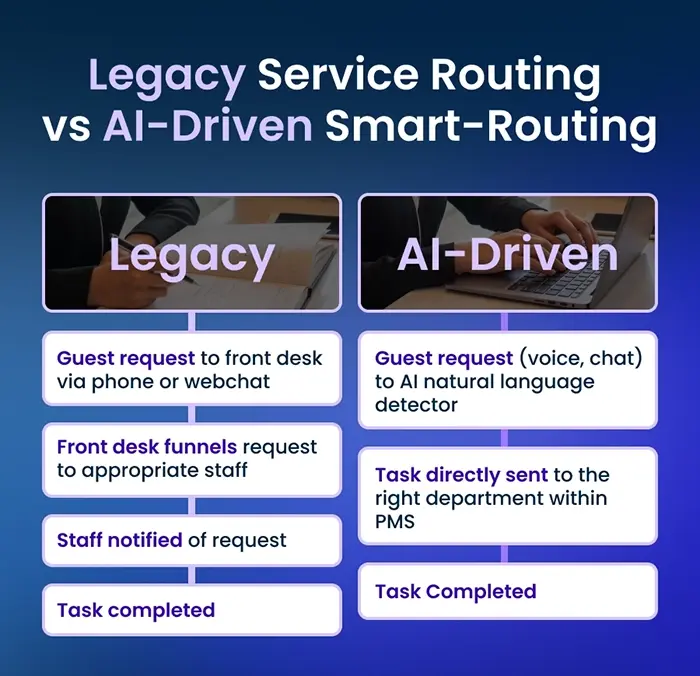
Faster response times: When a guest request bounces between departments and systems, every handoff is another opportunity for delay. Optimization means a request for extra towels can move directly to housekeeping instead of sitting with the front desk until someone passes it along.
Fewer maintenance issues: Missed or delayed maintenance requests turn a small problem into a larger, more expensive repair. Automatically routing a report of a leaking faucet to engineering gives the team a chance to address it before it causes room downtime or water damage.
Less manual coordination: Staff often spend valuable time tracking down the right person and following up on requests that fall between disconnected systems. Strong hotel productivity strategies like this reduce administrative burden, giving teams and guests more time to connect.
How to Optimize Hotel Services with AI
AI gives hotels a way to move beyond simply responding to requests faster. The right systems can understand what guests need, take action across connected tools and route work to the right team without adding another manual step.
Here are seven ways to use AI to create a faster, more coordinated service operation.
1. Centralize Guest Requests in an AI-Monitored Inbox
Bring guest messages into one place so AI can identify, categorize and respond to routine requests around the clock. An AI guest messaging platform gives your team a clearer view of incoming conversations and history across communication channels so guests never have to repeat themselves. It also automates the recurring questions that would otherwise pull staff away from guests.
2. Personalize the Guest Experience
AI can use available guest context to deliver more relevant responses, recommendations and offers. Instead of treating every interaction as a blank slate, hotels can create service experiences that reflect a guest’s needs and where they are in their journey.
3. Auto-Generate and Route Tickets
AI can turn a guest request into a task without requiring staff to manually create and assign it. With solutions like the Amadeus HotSOS integration and Quore task management integration, requests can move from conversation to the appropriate team in one connected workflow.
4. Connect AI to Maintenance and Housekeeping Systems
AI becomes more valuable when it triggers action across the systems your teams already use. Connecting AI with operational workflows supports teams in taking action and powers the kind of hotel housekeeping best practices that keep teams one step ahead. Clever integrations align actions and prevent requests from getting lost between departments.
5. Flag Maintenance Issues Before Guests Report Them
Over time, connected AI systems can identify patterns that signal potential service or maintenance issues before they become larger problems. Patterns in repairs, outages and maintenance call-outs can be analyzed in the background and brought to your attention where needed. Combined with the insights in this hotel performance analytics guide, that visibility gives teams more opportunities to shift from reactive service to proactive action.
6. Let AI Triage Multilingual and After-Hours Requests
Guest service does not stop when the front desk gets busy or a shift ends—it becomes more critical, not less. AI becomes a crucial support system that can manage routine requests across languages and after hours, giving guests faster answers while ensuring more complex issues reach the appropriate team.
7. Keep a Human in the Loop for AI Escalations
Not every request should be automated. The strongest AI workflows recognize when an issue needs human judgment and route it to a staff member with the right context, giving teams control while reducing the volume of repetitive work.
Why You Need an AI-Powered Hotel Service Optimization System
An AI-powered hotel service optimization system connects the guest and operational workflows that are often spread across separate tools — the phone calls, radio check-ins and spreadsheets that slow teams down. When AI has a complete view of what is happening across the property, it can help teams respond faster and keep work from falling through the cracks.
It keeps requests and tickets connected: When guest requests and maintenance tickets live in separate systems, teams can lose visibility into what has been completed and what still needs attention. For example, a guest who reports a clogged drain wants an update — but the front desk has no way to give one unless engineering's progress is reflected in the same system.
It reduces duplicate work: Disconnected systems often require staff to enter the same information multiple times. AI integrations can move request details between connected workflows without staff copying and pasting, reducing manual data entry and the errors, frustration and delays that come with it.
It spots patterns across the operation: Recurring service and maintenance issues are harder to identify when the data is spread across multiple platforms such as the PMS, housekeeping or maintenance systems. A connected view can reveal patterns, such as repeated, potentially related requests for the same room or a recurring guest issue that points to a larger operational problem.
It gives AI the context to take action: AI can only prioritize, route and escalate effectively when it has visibility into the full request lifecycle. When every request is connected, AI can recognize urgent issues and route them to the right team instead of waiting on a member of staff to triage the next step.
What Should You Look for in a Hotel Service Optimization App?
A hotel service optimization app should connect the systems your teams rely on while giving AI the context and flexibility to automate requests without losing human oversight. Think of it this way: the great advantage humans have had over tech is that they talk to each other. An AI agent can talk to any of your systems based on how you train it.
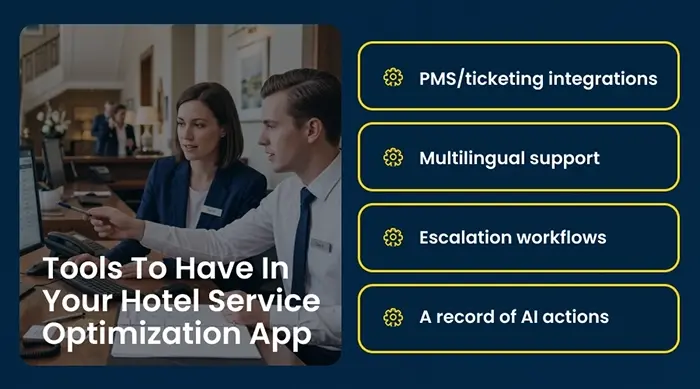
PMS/ticketing integrations: The app should connect with the systems where guest and operational data already live. This allows requests to move between guest communication, the PMS and task management tools without staff re-entering information.
Multilingual support: Guests should be able to easily communicate in their preferred language. AI-powered translation can help hotels finally achieve the vision of faster, more consistent service across a global guest base.
A human escalation path: AI should know when to hand a conversation or task over to a team member. Clear escalation workflows ensure complex, sensitive or unusual requests get the right level of human attention.
An audit trail of AI actions: Teams need visibility into what AI has done and why. A clear record of actions makes it easier to track requests, understand outcomes and maintain oversight across automated workflows.
Optimize Hotel Services with Canary
Hotel service optimization works best when AI can do more than answer guest questions. Canary AI hospitality platform connects guest communications with the workflows and systems hotel teams rely on, helping requests move from conversation to action. With the Canary AI, hotels can:
Automate routine guest requests: Give guests instant answers while reducing repetitive work for hotel staff.
Route requests to the right team: Turn guest conversations into actionable tasks that can flow into connected operational systems.
Support guests across languages and channels: Deliver consistent service wherever and however guests choose to communicate.
Keep staff in control: Escalate complex or sensitive requests to the right team member when human attention is needed.
Ready to see how Canary can help your team optimize service across the guest journey? Book a demo.
Frequently Asked Questions
What Does Agentic AI Actually Do in Hotel Service Operations?
Agentic AI goes beyond answering questions. It can understand a request, trigger the next action and set off workflows across connected hotel systems while escalating any sensitive or complicated issues to staff.
Can Agentic AI Coordinate Across Departments on Its Own?
Yes, when it is connected to the right systems and workflows. For example, AI can turn a guest request into a ticket and route it to housekeeping or engineering while keeping the relevant teams informed.
How Does Agentic AI Support Predictive Maintenance in Hotels?
AI can help identify recurring issues and patterns across maintenance data, making it easier for teams to act on potential problems earlier. The more connected data AI can analyze, the better positioned hotels are to move from reactive repairs to proactive maintenance. AI becomes an always-on layer of visibility across the property.
What Routine Back-Office Tasks Can Agentic AI Take Over Completely?
Agentic AI can automate repetitive tasks such as answering common guest questions, routing requests, creating tickets and escalating issues when needed. This reduces manual coordination so staff are freed up to engage with guests.
How Much Does Customer Service Optimization for Hotels Actually Save?
The savings depend on a hotel's size, staffing model and existing technology. The biggest impact typically comes from reducing repetitive work, avoiding duplicate data entry and helping teams resolve requests faster without adding headcount.