In the hospitality world, a single bad review can be chalked up to a mistake. Two bad reviews about the same issue? That’s when potential travelers might press pause. In a competitive market, hotels don’t have the luxury of letting negative feedback languish — if they do, they stave off potential customers and hurt their bottom line. And if you treat feedback as a one-off annoyance rather than a roadmap, you miss the “why” behind the “what.”
Hotel feedback analysis is a structured, data-driven approach to improving the guest experience. Instead of reacting to individual comments, you identify trends, prioritize fixes and uncover new revenue opportunities hidden in guest sentiment. In this guide, we’ll show you how to uncover the truth in guest feedback.
Key highlights:
Hotel feedback analysis is the process of collecting and interpreting guest reviews to uncover actionable insights that improve operations and drive revenue.
Identifying trends across feedback helps you prioritize the changes that matter most to guests.
Turning unstructured reviews into structured data leads to faster, more confident decision-making across teams.
Canary AI transforms guest feedback into clear, revenue-driving actions across the entire guest journey.
What Is a Hotel Guest Feedback Analysis?
Hotel guest feedback analysis is the step between collecting and acting on reviews. It includes evaluating feedback and using sentiment analysis to plan changes that improve operations and guest satisfaction. The task is to transform unstructured comments into clear trends, priorities and opportunities.
To get to the meat of the message in your guest feedback, you need strong online review management practices that produce a holistic view of the guest experience. The result of solid hotel guest feedback analysis is an action plan that, when continuously delivered upon, supports high review scores and revenue goals.
How to Manage Review Insights for Hotels
Reading reviews isn’t enough. Imagine a guest leaves a three-paragraph vent because their shower drain was slow on Tuesday. If you focus too much on that one drain, you might miss the three generally positive reviews that mention a strange smell in the north elevator.
Review sentiment analysis serves as triage. It strips away the hyperbole to find the patterns, turning scattered feedback into a prioritized hit list for your team. Here’s how to start:
1. Centralize Guest Feedback
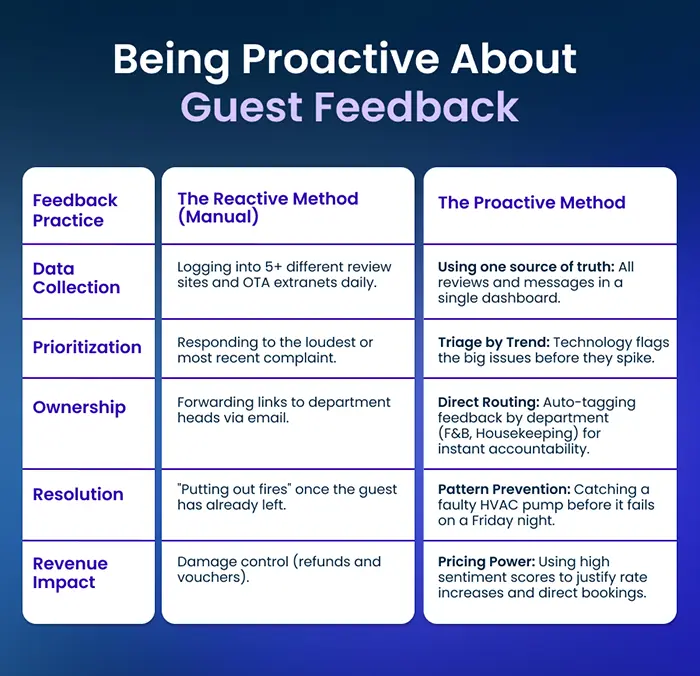
Guest feedback lives everywhere: review sites, Online Travel Agencies (OTAs), surveys, direct messages and social media. When this data stays siloed, it’s easy to miss the full picture of the guest experience and overlook critical trends.
When you centralize feedback into a single system, such as Customer Experience Management (CXM) tools, you start with one source of truth. Once your team sees all guest ratings and reviews in one place, it’s easier to identify issues and respond quickly. This is how to centralize your reviews:
Use APIs or direct integrations into a CXM to gather reviews from across OTAs, surveys, messaging platforms and social channels.
Automatically sync and update incoming reviews in real time so no feedback gets missed or delayed.
Standardize data formats across channels (ratings, timestamps, categories) to make analysis consistent and reliable.
Use a unified dashboard that displays all guest ratings and feedback in one place, giving your team a single source of truth for faster decisions.
2. Identify Patterns with Sentiment Analysis
Tripadvisor users produced 31.1m reviews and even more photos in 2024, according to the site’s 2025 Transparency Report. The sheer volume of reviews these days demands hotel guest feedback analysis because it evaluates large volumes of feedback for sentiment instantly, identifying whether comments are positive, negative or neutral (and why!).
A structured approach brings your attention to issues and strengths across your property, often through visualizations of word sentiment analysis or word clouds. From there, deeper dives into specific topics become possible. To use sentiment analysis:
Define your goals and metrics first: When service standards are clearly defined, any deviation becomes obvious.
Choose a sentiment analysis tool or AI platform: It should be able to process hotel-specific language and integrate with your guest feedback systems.
Train and refine the model: You’ll want to tag sample feedback, validate accuracy and continuously improve how sentiment and themes are classified.
3. Categorize Feedback by Department or Theme
Not all feedback belongs to the same team. Categorizing it makes sure valuable insights don’t get lost or delayed before reaching the right stakeholders.
Organizing feedback by themes, such as service, rooms, facilities or F&B, creates a sense of ownership that’s crucial for follow-up. Psychology Today points out that taking ownership of a task is directly linked to intrinsic motivation and initiative. This speeds up resolution and drives accountability across your operation. To ensure feedback reaches the right teams quickly:
Tag feedback by department (front desk, housekeeping, F&B)
Group comments by themes like cleanliness or service
Route insights directly to responsible teams
4. Track Trends Over Time
A single review tells a story. Trends tell you what’s really happening — and this time we don’t just mean quantitative trends, but historical ones. If service speed in your restaurant was an issue three months ago, you’d expect that problem to be mentioned less or not at all after having hired extra staff.
Tracking feedback over time reveals whether changes are improving the guest experience or creating new issues. With consistent tracking, you move from reactive fixes to a proactive strategy. You spot seasonal patterns, measure performance shifts and validate operational decisions with real data. To turn feedback into long-term performance insights:
Monitor changes in sentiment over weeks or months
Identify seasonal or recurring issues
Measure the impact of operational changes
Benchmark performance against past results or targets
5. Turn Insights into Tasks
Insights only matter if they lead to action — a resolution presented to an unhappy guest or the repair of broken processes or fixtures. You don’t want to apologize to one guest for an issue while it’s happening to another. When you don’t have a clear process of dealing with feedback, insights stay theoretical and problems persist.
You can ensure accountability and follow-through by turning your insights into tasks. Solutions are reached quickly when feedback directly triggers workflows. To drive action and accountability from guest feedback:
Assign tasks based on specific feedback trends
Set priorities centered on impact and urgency
Track resolution progress across teams
Close the loop with guests and improve satisfaction
Why Sentiment Analysis of Reviews Matters for Reputation and Revenue
If a hotel increases its review scores by 1 point (on a 5-point scale), it can increase its price by 11.2% and still maintain the same occupancy or market share, according to a report from Cornell. It’s clear: sentiment analysis for hotel reviews directly impacts both guest satisfaction and revenue performance.
When you perform sentiment analysis for hotel reviews at scale, you stop scratching the surface and get into actionable insights that shape how guests perceive your property, whether they choose to book and how much they’re willing to pay.
It Strengthens Your Hotel Reputation Management
Your guests’ perception determines your online and offline reputation, even if you have the best branding in the world! Gaining a thorough grasp of how visitors actually feel and what motivates their reviews is the first step in shaping that perception.
When you analyze guest sentiment on an ongoing basis, you have your finger on the pulse. Now you can respond strategically, improve weak areas and strengthen your reputation management efforts over time. To improve your hotel’s reputation:
Address recurring negative sentiment before it escalates
It Increases Direct Bookings Through Positive Reviews
Over 30% of direct bookers find you on a third-party site and visit your website to validate their choice — what’s known as the “the billboard effect,” according to Cornell. Hotels that feature clear, positive sentiment as social proof exude trust, which converts to direct bookings.
However, it’s not as simple as displaying a few one-liner, non-specific “great stay, would return” reviews. When you’re crystal clear on what guests love and why they choose you over the competition, you can increase direct bookings. To drive more direct bookings with reviews:
Identify top-performing experiences mentioned in positive reviews
Showcase guest-loved features in your marketing and booking channels
Ensure consistency in experiences that drive high ratings
Align your operations with what your guests value most
It Reduces Negative Review Volume Over Time
Negative reviews often stem from recurring issues like unvalidated parking tickets or unprocessed breakfast credits. When a pattern gets missed, those problems continue to impact new guests.
When you consistently analyze guest sentiment, you uncover root causes behind any negative feedback. Actually acting on these insights cuts out those issues and improves overall guest satisfaction. To reduce negative reviews:
Detect patterns in recurring complaints across departments
Prioritize fixes based on frequency and guest impact
Implement operational changes to resolve root issues
Monitor sentiment trends to ensure improvements stick
It Identifies Revenue Opportunities Hidden in Guest Comments
“The pool was fantastic, we spent all day there. The only downside is we had to bring our own snacks.” This is a guest ready to spend some cash for poolside refreshments! Guest feedback often reveals what guests are willing to pay more for.
By analyzing sentiment tied to amenities, services and experiences, you’ll uncover ways to boost hotel revenue. This allows you to refine upsells, pricing strategies and service offerings based on real guest demand. To uncover revenue opportunities:
Identify highly praised amenities and premium experiences
Expand or promote services that are asked for
Adjust your pricing strategies based on perceived guest value
Align upsell offers with what guests already love
Advantages of a Hotel PMS with Automated Guest Feedback Analysis
So, how do you take advantage of valuable guest feedback data without losing time reading every review? Automation. With guest sentiment analysis on autopilot, you move away from a manual, reactive approach. Instead, you get to proactively make improvements that actually move the needle on the guest experience.
Integrating hotel feedback analysis directly into your Property Management System (PMS) and daily operations decreases response times and makes feedback management a regular practice.
All-in-one solutions and simple add-ons make it possible for review data to flow into one system. Your team gains valuable insights faster and delivers stronger customer service without adding manual work. You get:
Real-time feedback collection and alerts: Review data is captured and processed instantly, alerting staff to issues as they happen for immediate action and stronger customer service.
Automated sentiment analysis built into workflows: Sentiment analysis is done automatically within daily workflows, turning raw review data into valuable insights without manual effort.
Unified guest data for deeper insight: Review data is combined with guest profiles to unlock valuable insights that improve personalization and overall customer service.
Faster service recovery: Feedback is immediately usable to resolve issues quickly, improving customer service and reducing negative review impact.
How Hotel Feedback Review Analysis Enhances Guest Experience
Hotel feedback analysis should improve the entire guest journey, from discovery to post-stay. By turning negative feedback into actionable improvements, your front desk and operations teams deliver a stronger customer experience at every touchpoint.
It Personalizes Guest Engagements Based on Feedback
Every guest has different preferences, and feedback reveals what matters most to them. Without analyzing it, personalization is just guesswork; with hotel feedback analysis, customer segments and preferences become clear.
By using insights from past reviews and surveys, you can tailor offers to a specific guest (or many guests in the same demographic!). This creates more meaningful guest engagement and strengthens loyalty.
It Anticipates Issues Before They Escalate
If three different guests over a 48-hour period all mention the AC in their checkout surveys, you’ll want to pay attention! Sentiment analysis will connect the dots to identify patterns that may have previously been missed — like an indication that the entire floor’s AC is breaking down.
Negative feedback often follows patterns. Spot them and you prevent problems before they impact more guests. Hotel feedback review analysis highlights recurring topics so your team can act proactively. This reduces complaints, improves service consistency and protects the overall guest experience.
It Improves Staff Training and Accountability
Guest feedback provides direct insight into team performance across departments. Use specific examples of great service, highlighted by guests, to train more staff and shape your service culture.
For example, tying feedback to specific roles and highlighting it at stand-up meetings lets you both identify gaps and reinforce best practices. This makes meetings and staff training more targeted and effective.
It Creates a Continuous Improvement Loop
Guest expectations evolve quickly. Static processes lead to outdated experiences and declining satisfaction. But how to keep up?
With ongoing feedback analysis, your team already has prioritized, continuous input to refine operations. This creates a cycle of improvement that keeps your customer experience aligned with what guests expect.
Boost Guest Sentiment and Drive Better Experiences with Canary
Canary delivers a modern guest experience platform that centralizes guest feedback, automates analysis and turns insights into immediate action. Instead of manually reviewing feedback, your team gets real-time visibility into sentiment and clear next steps to improve performance.
With Canary, you:
Centralize guest messages and surveys in one platform
Trigger real-time alerts and workflows for faster issue resolution
Improve customer service with faster, data-driven responses
Provide personalized upsells in response to guest requests
Identify trends that boost guest satisfaction and revenue
Book a demo today and see how Canary couples with hotel feedback analysis for an enhanced guest experience.